Good League Hence
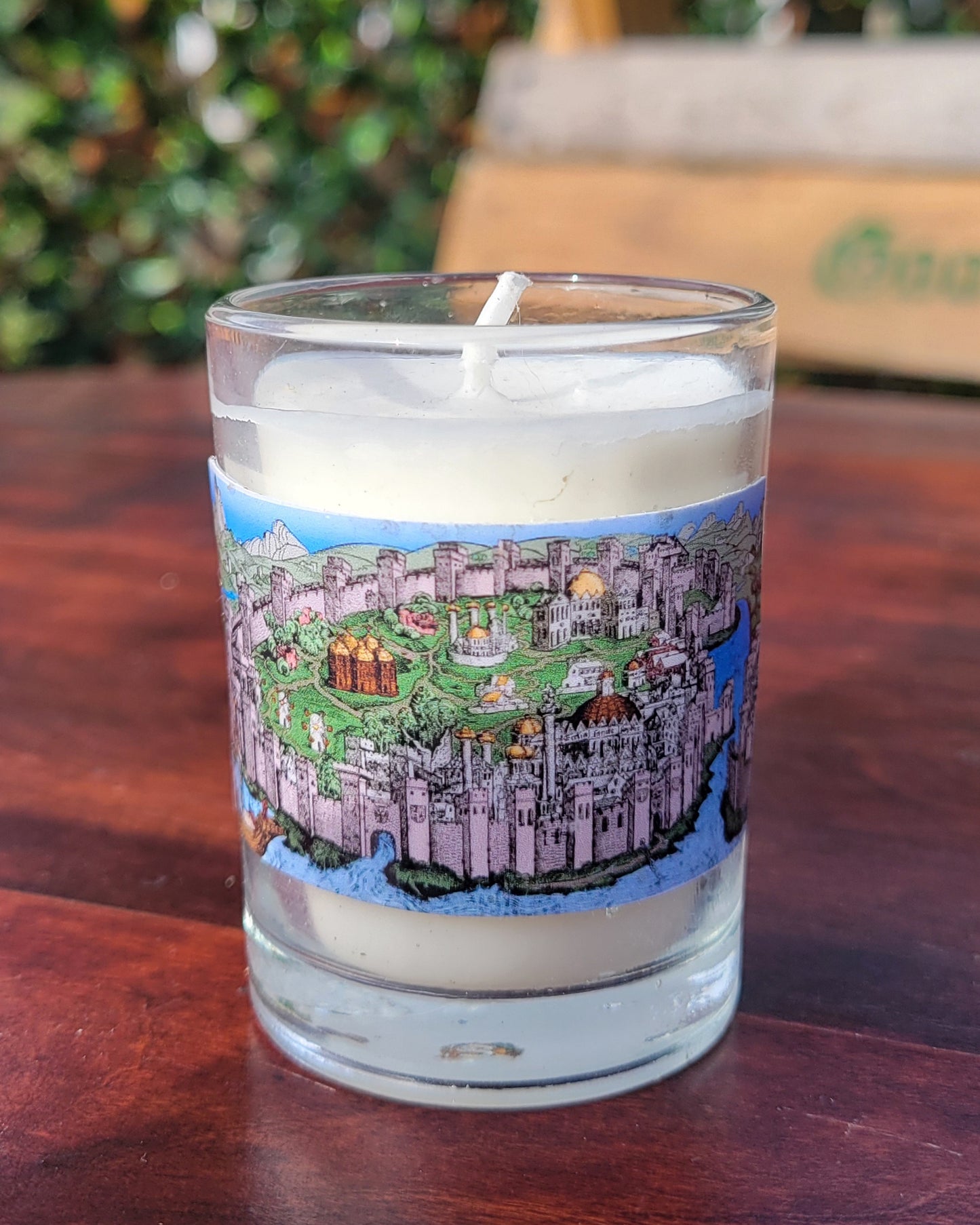
Constantinople - Queen of Cities Historical Candle
Constantinople - Queen of Cities Historical Candle
Couldn't load pickup availability
Remember the city that stood at the meeting place of empires with the Constantinople Historical Candle. Celebrating the former capital of the Eastern Roman Empire, this educational candle makes a distinctive gift for admirers of Byzantine history, sacred architecture, Eastern Christianity, and the civilizations of the Mediterranean.
The Founding of a New Rome
Constantinople began as the ancient Greek settlement of Byzantion. Recognizing the strategic importance of its location, the Roman emperor Constantine the Great transformed the city into an imperial capital. Dedicated in AD 330 as New Rome, it soon became more commonly known as Constantinople—the City of Constantine.
Situated beside the Bosphorus, the city commanded the passage between Europe and Asia and between the Black Sea and the Mediterranean. Its natural harbor, the Golden Horn, supported commerce, naval power, and communication across the Roman world.
Capital of the Eastern Roman Empire
After the political division of the Roman Empire, Constantinople became the capital of its eastern territories. The empire governed from the city endured for nearly a thousand years after imperial rule disappeared in the West.
Although modern historians commonly call this civilization the Byzantine Empire, its people understood themselves as Romans. Constantinople preserved Roman government and law while developing a distinctly Greek-speaking and Christian culture.
Behind the formidable Theodosian Walls, the city became one of the medieval world’s largest, wealthiest, and most cosmopolitan centers. Merchants, pilgrims, diplomats, soldiers, and scholars arrived from throughout Europe, Africa, and Asia.
A Center of Christian Civilization
Constantinople was also one of Christianity’s most influential cities. It became the seat of the Ecumenical Patriarch and the setting for major theological controversies, imperial ceremonies, monastic communities, churches, and charitable institutions.
Its most celebrated monument was Hagia Sophia. Completed under Emperor Justinian I in AD 537, the immense domed church represented an extraordinary achievement of Roman engineering and Byzantine sacred art. Its architecture, mosaics, and ceremonial importance influenced religious buildings throughout both the Christian and Islamic worlds.
Conquest, Survival, and Transformation
Constantinople’s history was not one of uninterrupted splendor. The city survived repeated sieges but suffered a devastating sack by the forces of the Fourth Crusade in 1204. Byzantine rule was restored in 1261, although the empire never completely recovered its former power.
In 1453, Sultan Mehmed II conquered Constantinople and made it a capital of the Ottoman Empire. Churches, palaces, markets, mosques, and neighborhoods from successive civilizations shaped the city that became modern Istanbul.
Constantinople therefore represents more than a vanished empire. It is a testament to the preservation, exchange, and transformation of ideas across centuries—a city where Roman, Greek, Christian, Ottoman, European, and Asian histories continually encountered one another.
The candle’s label presents an image associated with historic Constantinople. The title, artist, and date of the original artwork should be added once its source has been confirmed.
A Meaningful Historical Gift
This candle is especially suited for:
-
Students and teachers of Roman or Byzantine history
-
Admirers of Hagia Sophia and sacred architecture
-
Eastern Orthodox and Byzantine Catholic households
-
Collectors of historical maps, cityscapes, and educational décor
-
Readers interested in the Crusades and Ottoman history
-
Anyone fascinated by the meeting of Europe and Asia
Candle Details
-
Historical subject: Constantinople
-
Modern city: Istanbul, Türkiye
-
Founded as an imperial capital: AD 330
-
Featured history: Eastern Roman and Byzantine civilization
-
Label artwork: Historical image; attribution to be confirmed
-
Small: Approximately 2.5 inches high with a 1.5 × 1.5-inch base
-
Cube: Approximately 2 × 2 × 2 inches
-
Large: Approximately 3 × 1.5 × 1.5 inches
-
Made by: Good League Hence
Dimensions are approximate and may vary slightly.
Share